The 2022 True-Talent All-Stars

Featured

Major League Baseball’s All-Star Game is certainly the best of its kind, the progenitor of the concept in major American sports leagues, with a history and seriousness to it that the other league’s games, where a single game played at full intensity takes more out of the player than the “pace yourself, we’re playing 162 of these” nature of baseball.

That being said, the All-Star Game is hurt by what I view as a silly belief from fans, especially fans who think of themselves as more informed, to treat the Game as just a place to put guys who had the best first halves, instead of who is actually the best at each position in terms of true-talent. That is to say, if you think of a player’s output as being their true-talent level plus-or-minus some degree of luck that evens out over the course of multiple years of games, I’m trying to select the guys who I believe have the highest level of that right now.

What follows is a selection of nine hitters (the fans pick the position players and not the pitchers, so I felt it was fitting to match that here, also because I wanted this to actually be finished in time for the All-Star Game), positioned as I think makes the most sense, which means I’m willing to shuffle the outfield around a bit to fit the three best outfielders in there, even if they don’t usually play that specific outfield spot. Think of this as the actual alignment one would run out if given a roster of these players. In addition to each player’s stats through July 4th, the day before this article’s publishing, I will be providing the rest of season projections by the sZymborski Projection System (ZiPS) to give a sense of their true-talent level.

Also, this idea isn’t original to me, Joe Sheehan of the eponymous newsletter runs the same basic idea in a column every year, this is merely an expansion on that concept, leaning all the way into it and providing more words on each individual player, and my own choices are somewhat different from his. Despite what you might think, all sabermetric-minded baseball writers do not have the exact same opinions.

All of that preamble having been complete, onto the All-Stars. Tremendous apologies to Rafael Devers and Paul Goldschmidt, the players having the best season in each league that didn’t make it on due to superior competition at their respective positions.

American League

Catcher: Alejandro Kirk, Toronto Blue Jays. This says more about the rough state of the catcher position right now than anything else, at a time when catchers are almost exclusively picked based on how well they can frame pitches (read: lie to umpires), offense at the position is pretty dire. With the other two best hitters eligible for this position, Salvador Perez and Yasmani Grandal, having starts to 2022 of true ignoble ass-ness (wRC+ figures of 88 and 60, respectively), that leaves this majestic Mexican bowling ball as our choice.
Kirk was rushed to the Major Leagues at age 21 for a Blue Jays playoff run in the weird 2020 season. And he struggled from a lack of playing time and injuries despite playing quite well when he got the chance over 2020 and 2021. This year though, he’s found another gear, massively improving his defense at catcher while being the absolute best version of himself at the plate. Maintaining both a slugging percentage north of .500 and walking more than he’s striking out in this offensive environment is something only one other player in baseball is managing this year. And when comparisons can be drawn between you and Jose Ramirez at the plate, you’re doing a lot right.
2022 batting line: .315/.405/.505 (159 wRC+)
ZiPS projected true-talent batting line: .276/.358/.462 (132 wRC+)

First Base: Vladimir Guerrero Jr., Toronto Blue Jays. I feel like I might need to recuse myself from this. More sincerely, I think everybody serious agrees with me, so let’s go over some old points. Vladimir Guerrero Jr. hits the ball harder than anyone in baseball not named Aaron Judge or Giancarlo Stanton, and he has significantly better bat to ball skills than either of them. He’s a modern-day Miguel Cabrera, a right-handed hitting first baseman who hits lots of home runs despite not being a home run hitter. Ask him about it and Guerrero will say that he detests an uppercut swing, he’s trying to maximize batting average, not slugging, it just so happens that he hits the ball so hard that it often leaves the park. Nobody with as good a power tool as him has as good a hit tool, and nobody with as good a hit tool as him has as good a power tool.
Vlad had sort of a slow start to 2022, but it was mostly caused by an extremely low BABIP than anything particularly skill-related, and he’s recovered. The man is a very classical type of power hitter, and I’m extremely lucky to have been able to follow his career so closely.
2022 batting line: .266/.352/.497 (137 wRC+)
ZiPS projected true-talent batting line: .293/.379/.561 (162 wRC+)

Second Base: Jose Altuve, Houston Astros. Two years ago, the Houston Astros were Public Enemy #1 in baseball for their system of using trash can bangs to parlay stolen signs from the center field camera in Minute Maid Park to tell hitters what pitch was coming. But looking through the audio of the bangs, it’s clear that the AL MVP that year was clearly having no part in this scheme, Jose Altuve had a rough 2020, which many uninformed people attributed to him somehow being found out for this and no longer having able to be good without cheating. Turns out it was just rough variance in a 60 game sample.
Altuve has reinvented himself since the pandemic, going from the short slap hitting middle infielder he so perfectly exemplified beforehand to a true power threat who was okay with elevating his strikeout rate a bit to get there. Producing a number of home runs that seem impossible for a man of his stature. Jose Altuve did nothing wrong, and he’s out here to continue proving the haters wrong.
2022 batting line: .278/.363/.532 (159 wRC+)
ZiPS projected true-talent batting line: .275/.346/.482 (139 wRC+)

Third Base: Jose Ramirez, Cleveland Guardians. After a winter of blue balls with trade negotiations, Ramirez agreed to take a sweetheart deal to stay in the only American city he’s ever truly known. With $141M guaranteed to come to him and a less racist set of team branding, Ramirez, who really should’ve won AL MVP in 2020, is dragging his team kicking and screaming to playoff contention in an effort to actually win one this time (if the season ended today, I’d vote for him). The man has simply refused to strike out this year, without sacrificing an ounce of his power. He’s also a surprisingly good fielder and baserunner for someone as chubby-looking as him.
Ramirez has always been a great contact hitter, but he’s truly taken a step up this year, cutting his K rate almost in half from last year. This is where a boomer would say something like “you know they really don’t make hitters like this anymore” but they’ve almost never made hitters like this, who can strike out under 10% of the time and crank out 30 homers, it’s just not supposed to work that way, and yet for Jose Ramirez, somehow finding another level in his already fantastic career, it does.
2022 batting line: .289/.374/.577 (166 wRC+)
ZiPS projected true-talent batting line: .279/.369/.554 (159 wRC+)

Shortstop: Xander Bogaerts, Boston Red Sox. Look, he’s benefitting from a truly astronomically unsustainable .406 BABIP right now (well, he was at the time I wrote this, but it’s since come back down to earth, making this paragraph seem unnecessarily harsh in hindsight). But Lindor is in the National League now and Bo Bichette and Corey Seager are having down years, so here we are. Bogaerts has always been a great hitter who runs high BABIPs, but the batting average stratosphere he’s elevated himself into here is mostly an illusion. All of that said, we should celebrate what Bogaerts has been able to do in a year where he’s up for some big money if he opts out of his contract. Peppering baseballs around Fenway Park while seeming to make genuine improvements in his shortstop defense after refusing to switch to second for Trevor Story. And since 2019, his batting averages have been .309, .300, .295, and .318. Batting average isn’t everything, but when you can so consistently put dents in that Green Monster while playing, I’ll call it acceptable, defense at the most valuable non-catching position and being reasonably fast, that’s worth a lot.
2022 batting line: .318/.391/.456 (140 wRC+)
ZiPS projected true-talent batting line: .296/.370/.489 (142 wRC+)

Left Field: Kyle Tucker, Houston Astros. Maybe the most underrated player in baseball? Just solidly above average at all aspects of the game, without being truly transcendent at any, that tends to lead to being underrated. Above average batting average, above average OBP, above average slug, but the highest he ranks in any of them is 13th in the American League. Really good corner outfield defense and baseruning too, but he’s probably not going to be winning any Gold Gloves or fighting for a stolen base title.
Such is the curse of the solid all-rounder in baseball, for they do not inspire rabid Twitter stanning or flowing prose from pretentious writers, they are cursed to be underappreciated in their time. But if you know what to look for, Kyle Tucker has silently become the bedrock of the Astros position player core.
2022 batting line: .259/.351/.490 (143 wRC+)
ZiPS projected true-talent batting line: .280/.352/.521 (150 wRC+)

Center Field: Mike Trout, Los Angeles Angels. The greatest player of his generation is keeping it up, though he’s certainly beginning to show signs of aging in his speed and defense, the hitting remains as good as it’s ever been. A lower batting average environment has incentivized a more power-focused approach from Trout. Striking out more than he ever has in a full season, but when you seem to be ready to easily surpass 40 homers while still hitting for what for any other power hitter would be a very impressive batting average, all while playing (an albeit diminished) center field, you can get away with those strikeouts.
Fish Man good, and we’re getting to see Fish Man be good for an extended sample for the first time since 2019. He’s not giving up the title of best player in baseball without a fight.
2022 batting line: .272/.372/.623 (177 wRC+)
ZiPS projected true-talent batting line: .273/.404/.595 (179 wRC+)

Right Field: Aaron Judge, New York Yankees. Make the bad man stop. As a Blue Jays fan, no player on this list has caused me as much trauma as Aaron Judge, owner of a career .982 OPS against Toronto. This one is maybe the simplest explanation of anyone on here. Judge has cut his walk rate a bit from past seasons of his, and his batting average and OBP are nothing particularly notable this year compared to others for him (albeit his standards are excellent). But the home runs, holy shit the home runs. He’s on pace to be the first player since the steroid era to crank out 60, and while he almost certainly isn’t going to keep up that pace, he’s been doing it for a pretty impressive run of the season, especially with the deadened ball.
Oh, he’s also a really good outfield defender, that part of him is underdiscussed because of how fucking huge he is, but he’s a great all-around athlete.
The man is putting himself up for free agent sweepstakes with numbers not seen since Bryce Harper’s, and he’s a Yankee, so you bet this is one way to get mainstream media coverage around a baseball finance thing.
2022 batting line: .282/.362/.619 (1673wRC+)
ZiPS projected true-talent batting line: .278/.367/.563 (163 wRC+)

Designated Hitter: Yordan Alvarez, Houston Astros. Yordan Alvarez is a Cuban military project sent to America to crush baseballs. It’s been a long time since we’ve seen a full-time DH be this valuable overall (Ohtani doesn’t count). Alvarez was never a huge prospect, but starting in 2019 in the Minors, and then in the Majors, he just refused to stop hitting. Announcing his arrival on the 2019 Astros with half a season of 176 wRC+ hitting, with the exception of some pandemic weirdness he hasn’t looked back. He’s elevated it to a whole other level this year, just refusing to swing at bad pitches and cutting his strikeout rate dramatically. He’s hitting .310 right now and Statcast says he’s been underperforming his batted ball data, that’s how good he’s been.
He’s firmly entrenched himself with Vlad and Soto and Trout in the discussion for best hitter in baseball. We’re witnessing the best DH season since David Ortiz retired here, and that’s a wonderful thing to see.
2022 batting line: .310/.410/.653 (201 wRC+)
ZiPS projected true-talent batting line: .295/.377/.595 (177 wRC+)

National League

Catcher: Will Smith, Los Angeles Dodgers. Willson Contreras is the true NL catching story of the season, with an insane breakout season while Smith has been having a fairly pedestrian season. But the defensive gap between the two compresses this distance, and while the underlying stuff mostly supports the Contreras breakout being real, he’s almost certain to come down to earth at least a little here. Will Smith is a good defensive catcher with a career 134 wRC+, and his underlying hitting metrics are pretty similar to Contreras’. Give me the guy with the longer track record, elite plate discipline, and plus defense with both arm and glove, over the breakout that’s going to be traded for a big prospect haul at the deadline.
2022 batting line: .256/.344/.462 (127 wRC+)
ZiPS projected true-talent batting line: .256/.354/.499 (139 wRC+)

First Base: Freddie Freeman, Los Angeles Dodgers. This is the hardest position to pick, Paul Goldschmidt and Freddie Freeman are both future Hall of Famers having excellent years at the position, and Goldschmidt has been significantly better then Freeman in this time (he might win NL MVP). But I just think Freeman is a hair better by true talent. And the projection systems, especially ZiPS, seem to agree with me.
It’s a point that’s made pretty often, so it’s a bit played out, but it’s still worth talking about the unreal consistency of Freeman, since his breakout year in 2013, making this season number 10 of this run, Freeman has played at least 72% of his team’s games, had a batting average of at least .276, an on-base percentage of at least .370, and a slugging percentage of at least .461. His worst wRC+ over this time, ten years, is 132, and it’s averaged 144. There’s a quote about 1930s Detroit Tigers great Charlie Gehringer: “You wind him up in the spring and he goes all summer. He hits .330 or .340 or whatever, and then you shut him off in the fall.” That model of mechanical consistency can very much be said about Freeman, who, even if you ignore that Gehringer never had to face non-white competition, is a better hitter than he ever was. Off-the-field drama about his free agency last winter shouldn’t get in the way of this greatness.
2022 batting line: .302/.384/.492 (145 wRC+)
ZiPS projected true-talent batting line: .296/.381/.519 (150 wRC+)

Second Base: Tommy Edman, St. Louis Cardinals. Cardinal devil magic strikes again! What follows is a quote from the 2019 scouting report FanGraphs gave on Edman, who they ranked 20th in the Cardinals farm system as just a 40-grade player:

“Edman is a switch-hitting Joey Wendle. He just passes at shortstop and is a range-driven, above-average defender at second. He has more power when hitting right-handed but doesn’t project to much damage in games.”

Eric Longenhagen and Kiley McDaniel, 2019

Well, they were right about the lack of power, but dead wrong about the defense. Edman has racked up 15 Defensive Runs Saved, combined through great play at both middle infield positions, through the halfway mark of the season. No player in the National League has a higher Statcast Outs Above Average mark this season. And sure he’s only good for like 10 home runs a year, but he’s getting on base at a .335 clip, and that’s enough to make you an above-average hitter in this dead offensive environment, combine that with the excellent defense, and you’ve got an All-Star on your hands.
Edman is the proximate Cardinals Guy, player who doesn’t wow scouts thanks to no eye-popping physical tools, but excellent baseball IQ and well-rounded game sense to make him tremendously valuable. He doesn’t hit enough dingers to do well in the fan voting, but he better be getting his ticket to LA this All-Star Break somehow.
2022 batting line: .266/.335/.389 (109 wRC+)
ZiPS projected true-talent batting line: .273/.325/.404 (108 wRC+)

Third Base: Manny Machado, San Diego Padres. Machado is no stranger to controversy in his time, from stuff that he’s definitely brought upon himself (a slide into Dustin Pedroia in 2017 that, while certainly not intending to cause as much harm as it did, ignited a series of injuries that led to his career ending, and more recently the decision to wear a “Let’s Go Brandon” T-shirt into Spring Training) and some of which seems to be the sort of racist criticism a lot of Hispanic players who aren’t seen as “hustling” or “playing the game the right word” are often subjected to. All of that distracts from the actual player at the center of this though, which is a future Hall of Famer in his prime.
If the season ended today, Machado would be my pick for National League MVP, he’s continued to be the defensive stalwart he’s always been, and since the start of 2020, he’s added another gear to his hitting. He’s managed to hit the ball harder without sacrificing anything in terms of strikeout rate. Through this, Machado has managed to be a player who has roughly matched Fernando Tatis Jr. for best overall value on the Padres over this time thanks to the latter’s unfortunate injury history. A .300 average, 25-ish home runs, and elite third base defense, all in one of baseball’s hardest parks to hit in? That’ll play.
2022 batting line: .318/.392/.528 (156 wRC+)
ZiPS projected true-talent batting line: .286/.358/.493 (137 wRC+)

Shortstop: Trea Turner, Los Angeles Dodgers. Baseball’s fastest man over the last few years, Trea Turner has transformed himself from someone with amazing physical tools but not a ton of game power into a guy with a great hard hit rate combined with a line drive approach that makes him one of the few true talent .300 hitters in baseball. He’s still not a home run machine, but he’s got consistent doubles (and given his speed, triples) power with that approach, combined with typically excellent baserunning, he’s one of the best and most entertaining players in the National League.
This is his age-29 season, so it seems like he’s lost a step at shortstop (pretty rough Outs Above Average grades this year), and long-term he’s probably a second baseman with whomever he signs with this winter, but this is one of the few guys in baseball who can realistically be described as a five-tool player. Hitting .300, running a hard-hit rate north of 40%, at the top of the sprint speed leaderboards, and holding his own in the middle infield with both glove and arm. The complete package.
2022 batting line: .311/.359/.491 (138 wRC+)
ZiPS projected true-talent batting line: .304/.354/.506 (140 wRC+)

Left Field: Juan Soto, Washington Nationals. Baseball’s best hitter has also been among baseball’s unluckiest this year, with a truly horrendous .227 BABIP. His stats have declined from last year a bit in terms of the underlying stuff too, but that’s the main reason for his declined performance this year, and that’s not going to stick. Given all of that, I feel the need to point out that he still has an on-base percentage of .384, a slugging percentage of .449, a wRC+ of 134, and is one of just seven qualified hitters in baseball so far this year walking more than they strike out. All of this can I think provide further proof of Soto’s status as baseball’s best hitter, not scare people away from it, even in a situation where absolutely everything has gone wrong, he’s still going to end up in the All-Star Game. It’s assuredly frustrating to Nationals fans stuck watching a bad team to see him struggle like this, but long-term, it shouldn’t bother him that much, sometimes you catch the bad side of variance. Jose Ramirez ran a 72 wRC+ through the entire first half of 2019, and he came out the other end fine, Soto will be fine, and he’s still the best hitter on the planet, with plate discipline we haven’t seen since Bonds on steroids.
2022 batting line: .226/.384/.449 (134 wRC+)
ZiPS projected true-talent batting line: .289/.441/.545 (170 wRC+)

Center Field: Ronald Acuña Jr., Atlanta Braves. Look who’s back! After tragically tearing his ACL last July, preventing him from partaking in what turned out to be a World Series run for the Braves, he’s back, and while he’s still not totally up to speed both in terms of power and speed (though it seems like he’s become a better baserunner, even without the physical speed he had prior to the injury), he’s been pretty good. It’s just so nice to see someone come back from such a devastating injury in such a relatively short time with so little lost talent. He’s been hitting for average and walking a reasonable amount, so you’d think it’s just a matter of time before all systems are back online all the way.
When Acuña came back, the Effectively Wild podcast discussed him as being one of baseball’s “main characters” and I think that’s a good way to put it in terms of the sort of space guys like Acuña occupy. Last summer I wrote a four-part series on four young exciting players who I think present the most entertaining watches in baseball, and we started this year with only two of those four active, we’re back to three of four, and hopefully by the end of the month, Tatis will come back so we can have all four.
2022 batting line: .287/.386/.453 (134 wRC+)
ZiPS projected true-talent batting line: .279/.384/.538 (152 wRC+)

Right Field: Mookie Betts, Los Angeles Dodgers. I’m still in awe of the fact that the Red Sox, the Boston Red Sox traded this guy because they didn’t want to spend the money on extending him. Regardless, Mookie has been his usual fantastic self this year, barring a few weeks missed there for a broken rib. The average isn’t what it was in his best seasons, but barring further injury, he seems well set up to break his single-season home run record.
Excluding Vlad, for whom I have an unfair bias in favor of, Mookie might be my favorite player in baseball to watch. The best defensive corner outfield play of his generation, great speed, and a never-say-die plate approach that always makes him a threat, even with two strikes on him. No hitter in baseball has been better than Mookie Betts with two strikes over the last five years. He’s also frankly pretty cool in a way beyond even the baseball players with the most bombastic batflips for me, combining his style with a sense of just being a genuinely great guy (he’s been one of the most outwardly pro-vaxx guys in baseball, and was the lead player for the Dodgers’ Pride Night this year, one of the few American MLB players who I can be confident didn’t vote for Trump), plus he’s bowled multiple perfect games, what’s not to love?
2022 batting line: .278/.356/.540 (150 wRC+)
ZiPS projected true-talent batting line: .283/.373/.521 (150 wRC+)

Designated Hitter: Bryce Harper, Philadelphia Phillies. Unfortunately, he’s not going to be playing in this All-Star Game because he broke a finger getting hit by a pitch a couple weeks back, but that aside, Harper has very clearly been the best DH in the National League. Of course, Harper isn’t really a DH, but he tore his elbow early in the season, and to avoid doing the surgery to fix that until the offseason, he’s not playing the field. As for who he’s been as a hitter, Harper has picked up right from where he left off with his MVP campaign last year. He’s been more aggressive at the plate, cutting his walk rate dramatically, but similarly cutting his strikeout rate, he’s just putting the ball in play hard, and that’s been enough to get him to his highest batting average since his 2017 season.
In the time since Bryce Harper signed his eye-watering $330M deal with the Phillies ahead of the 2019 season, only five hitters in baseball have been better than him by wRC+: Mike Trout, Yordan Alvarez, Juan Soto, Fernando Tatis Jr., and Aaron Judge, that’s it. And all of those guys except Soto have played less than Harper. Harper is a classic power hitter that would play in any era, managing to hit his homers with enough plate discipline and bat-to-ball skills that his strikeout rate isn’t so high to scare teams in past, more whiff-phobic, eras. The debates about him vs Mike Trout that he could never win obfuscated the fact that this is still one of the greatest hitters who ever lived (23rd in post-integration career wRC+, minimum 3000 plate appearances), and a clear cut future Hall of Famer.
2022 batting line through July 4th: .318/.385/.599 (165 wRC+)
ZiPS projected true talent batting line: .284/.397/.559 (159 wRC+)

That’s all eighteen guys, if you’ve made it to the end, thanks for reading all this!

Cole Sulser: The Baltimore Orioles’ Best 2021 Reliever

Featured

The 2021 Baltimore Orioles are a bad baseball team, they might even be the worst team in Major League Baseball this year, in a dogfight with the Arizona Diamondbacks for the worst record (and consequently #1 draft pick) and have far-and-away MLB’s worst run differential. The biggest reason for this is their pitching staff is horrendous. Some facts about the 2021 Orioles pitching:

  • MLB’s worst pitching staff ERA and FIP
  • MLB’s worst starting rotation ERA and FIP
  • MLB’s worst bullpen ERA and third worst FIP

These are not the signs of a good pitching staff. But the nature of this series is that all teams must have one best reliever, and modern bullpens are so deep that even baseball’s worst pitching staff is going to have at the very least one worthwhile guy. Enter Cole Sulser, a 31 year-old right-hander who has been used as a sort of fireman guy, coming in usually with the game relatively close regardless of the inning, often with runners on base, often for more than one inning. Putting up a very respectable 2.79 ERA (though ERA for a guy who often goes into weird situations like this is not a great metric) and 2.97 FIP. Let’s talk about him.

The Background

Cole Sulser - Baseball - Dartmouth College Athletics
Sulser pitching in college for Dartmouth

Like many American MLB players, Cole Sulser was born and raised in the state of California, and coming out of high school as one of many Californian draft prospects, he went undrafted, and he went to New Hampshire to pitch in the Ivy League at Dartmouth College. In his first two years at Dartmouth, he was mostly a reliever, and then in his junior year his elbow gave out and he missed the rest of that season and his senior season with Tommy John Surgery, as a result, he still wasn’t getting any calls from Big League teams. He instead did something very unorthodox, asked to be a redshirt senior at an Ivy League school, something that very very rarely happens on both axes, and certainly doesn’t really have “future successful Major League pitcher” written on it. He stuck with it though, and after 204.1 college innings with a 4.18 ERA, the Indians finally picked up the phone and signed him in the 25th round of the 2013 draft. It’s hard to overstate how remote someone’s odds of making the Major Leagues are at this point, a Tommy John survivor who wasn’t selected in the draft until he was 23, and in a draft round so late that it no longer exists, is not really a prospect. And best I can tell Sulser never appeared on any prospect lists. Then, ahead of the 2015 season, at this point a 26 year old in AA, he had Tommy John again wiping him out for the year. This guy has had two major reconstructive surgeries, only got drafted in his last possible chance, and has made maybe less than $50K from his whole career of playing baseball to this point at age 26, the rational thing to do here would be to call it quits, but he stuck to it, eventually pitching about 100 good innings out of the bullpen in AAA through 2017 and 2018. And after 2018, Sulser had just about the best thing that can happen to a pitcher’s self-esteem, the Tampa Bay Rays traded for him. It was in the super bizarre Jerry Dipoto swishes the three-pointer from a hospital bed three-team trade between the Mariners, Indians, and Rays in that offseason’s Winter Meetings. Here’s how Jeff Sullivan (then of FanGraphs, now of those very Rays) talked about Sulser at the time:

As for Sulser, given that he’s almost 29 it’s doubtful he’s a long-term weapon, but he’s one of those sneaky high-level relievers who the Rays like for his performance, and for the fact he doesn’t yet have to be on the 40-man roster. Sulser spent last year at Double-A and Triple-A, and over 60.2 innings, the righty racked up 95 strikeouts against just 17 walks. In 17 innings over his final month, he had 28 strikeouts and only two walks. Despite being a righty reliever, he struck out half of the lefties he faced, so it’s easy to see how Sulser could make a difference this coming summer for a team that’s constantly churning through pitchers. The Dodgers just signed Joe Kelly for three years and $25 million. Sulser isn’t even costing the Rays a roster spot. There’s not a bad chance Sulser could be the better big-league reliever today. He’s not just a throw-in here, even though his is the least-familiar name. Few Triple-A pitchers put up better peripherals.

Jeff Sullivan, explaining the rationale of the team he’d be working for in a few months’ time.

Sulser debuted for the Rays in 2019, and was fine in a sample too small (7.1 innings) to make anything out of. He then got put on the waiver wire at the end of the season by the Rays and was picked up by the Orioles. Sulser got a chance to work as a high-leverage reliever for the 2020 Orioles, and he stunk. He walked almost as many as he struck out with a 5.56 ERA/4.91 FIP. If this was any other team in baseball, I think he’d start the next season in the Minors, but because this is the Orioles, and the standards here for pitching are, uh, not fantastic. He started 2021 in the Majors with a chance to prove himself as a core member of the Orioles bullpen, one more chance for a guy who’s gotten a lot of last chances that he’s succeeded in right under the wire. And, well, he’s made a pretty good go of it as a 31 year old with no prior Major League success.

The Profile

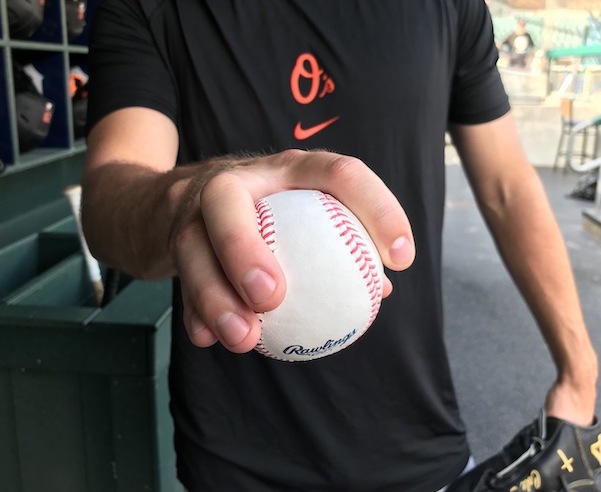
Sulser showing off his new changeup grip for 2021 in an interview with FanGraphs

Sulser is largely a three-pitch pitcher, he does have a curveball that he throws, but it’s so rare that it’s not really worth talking about. We should instead focus on the following:

The four-seam fastball (93.2 mph, 2290 rpm) is a pretty unremarkable pitch stuff-wise, its spin is good enough to give it some rising action above the average, but that velo isn’t gonna be blowing by anybody prepared for a modern bullpen. But he’s still turned it into a good pitch this year. The answer as to why is pretty simple, command. He’s felt far more comfortable throwing the heater up in the zone this year (for reasons we’ll discuss in a moment) and has been more accurate in his ability to locate it there, compare:

This has led the fastball to generate a pretty nice 28.9% whiff rate on the fastball compared to a 22.1% league average on four-seamers. The best-case scenario of this fastball is visible on this one to Shohei Ohtani, up in the zone with a high enough spin rate that the rising action fools him.

The worst-case scenario is that he doesn’t keep it up, it goes right down the middle, and the fact that it’s at 93 instead of 96 is made clear in a 400 foot long counterargument.

The secondary pitch is the changeup (84.0 mph, 1583 rpm), and it’s been the difference-maker that’s made this year the first that Sulser has actually had sustained MLB success. He used to hold it in a circle-change grip, but last season, Orioles pitching coaches got him to try throwing it with more of a split-grip (see above) where his index finger is still close to a circle with his thumb, but the distance between his index finger and middle finger is the whole distances between the seams. This has made it easier for him to mask it with his fastball, and using Baseball Savant’s spin-direction illustrator you can get a sense of the extent to which it is masked (this loops into a concept called “pitch tunneling” which is the art of making one pitch seem like another for as long as possible before it breaks off, having a consistent release point is another important factor here, and Sulser has a very consistent one between the fastball and change):

Image

Now, crucially, he did this in 2020, and he was bad in 2020, so what gives? I suspect this is a case of just needing time to get the hang of it. The command with the changeup wasn’t great in 2020, it’s the location of someone who’s under-confident in the quality of a pitch and is trying to nibble a little too much to the point where batters can just wait until one gets left up there (also to some extent this is just the small sample weirdness of 2020 not giving guys enough time to work things out properly). In 2021 he began throwing it down in the zone for more strikes, to the extent where his overall pitch heatmap has this really nice bifurcated look with fastballs up and changeups down:

A side effect of keeping it down (along with some arm-side movement) like this is that even if batters do make contact with it, it’s usually not squared up, the average exit velo off his changeup is a few mph slower than the league average for changes, and also slower than the average for noted soft-contact changeup artist Hyun-Jin Ryu’s slowball since 2018. I should note that it’s not a groundball pitch, just soft contact in general, it generates a lot of soft flyballs and pop-ups, and as such he’s the kind of pitcher who can actually run a sustained low HR/FB%, which he’s done both at the Major and Minor League levels for a long enough time to call it true-talent. But labeling it a soft contact pitch is underselling it when the pitch has a whiff rate of 34.6% and is being thrown in the zone at about a league average rate even with that. Let’s watch Shohei Ohtani strike out again, this time on the change:

Really textbook down and away changeup from an opposite-handed batter there. But while he certainly throws it more frequently if a left-handed batter is in the box, he still has about half of the strikeouts from it against righties, observe Giancarlo Stanton:

Finally, the slider (86.3 mph, 2266 rpm) is a tertiary pitch used more or less exclusively against right-handed hitters (hes thrown a grand total of 8 to lefties this year) for the purposes of having something that runs away from them. It’s a thoroughly unremarkable pitch that generates whiffs at a rate more than 10% below league average on sliders (25.6% of swings for his sliders vs 36.4% of swings for all Major League sliders). But still, it’s there, and it has struck out five guys, including Yuli Gurriel right here:

The Results

Whether the fact that Sulser has been more valuable than all but two Orioles pitchers this year, starter or reliever, says more about Sulser or the Orioles is left as an exercise for the reader

So how has this all of this worked out for Sulser? Pretty well, the changeup in particular has been a revelation this year, and I actually suspect he could get away with throwing it a bit more against right-handed hitters than he currently has. He has a higher strikeout percentage than anyone else on the Orioles, and while his walk percentage isn’t great by any means, it’s under 10% after a really worrying 15.5% rate across his first two Big League seasons. In terms of how the Orioles themselves view him, he went from being their closer entering 2020 to fighting for a Big League spot on the worst pitching staff in the American League to being their closer at the end of the season, he fought all the way back. He’s run the aforementioned ERA and FIP numbers above, though his Win Probability Added numbers haven’t been that great because he’s been “unclutch”, there’s no reason to think that’s anything but bad luck and maybe somewhat mean-spirited usage patterns by the manager. He pitches from the stretch with the bases empty, there’s no mechanical reason to think he’d be worse with runners on. Closing out here, let’s look at the pure results here, Cole Sulser has faced 250 batters this year, of those:

  • 73 struck out
  • 107 made outs some other way
  • 23 walked
  • 32 hit singles
  • 9 hit doubles
  • 1 hit a triple
  • 5 hit home runs

Pie charts are generally (and for good reason) considered the dregs of dataviz, but I think one might be useful here to get a sense of what your odds in the box are against Sulser, and I might close out future articles in this series out with it if I think it comes out well (or, maybe a better idea, use something better like a treemap when I put more forethought into it):

Next: Garrett Whitlock, the Boston Red Sox’s Best 2021 Reliever. (probably, it’s possible that by the time the season shakes out over this week that Matt Barnes leads the team’s relievers in fWAR, I will wait on pulling the trigger on the article until the end of the regular season as a result)

The Biden Approval Ratings Project

Featured

Joe Biden became President on January 20th, you may have noticed. Organizations often ask Americans whether they approve of the incumbent President. These polls are published in separate places and are more useful when they are put together in one place and averaged.

Well, I am introducing the Biden Approval Ratings Project. An open source polling average for Joe Biden’s approval ratings. I did some work in the past with polling averages in Excel for smaller-scale use, but now I think I can justify making this a regularly updated feature as a Python programmed product. There are still many issues with it, I have to manually do data entry to update it because of one Nathaniel Argent not doing the hard work of poll aggregation for me yet, and I could see an issue with the way I throw out older polls from the same pollster if two repeat pollsters publish on the same day (though I think there are not-too-bad ways to fix this).

As I write this: Biden’s approval rating stands at 55.2%, and I think that might go up as more high quality pollsters enter the fray. I will be writing proper documentation for it and hopefully making the program a bit more automated over time.

Thursday: Raising the minimum wage.

Steamer, Projections, and True Talent

Most Major League Baseball projection systems don’t come out until reasonably deep into the offseason, but the Steamer projections by Jared Cross, Dash Davidson, and Peter Rosenbloom, and hosted here on FanGraphs typically come out very early in the offseason, and that’s no different this year. So I think it’s worth looking through these briefly, but instead of just taking stock of them as predictions for what might happen in 2022, I think it’s useful to foreground what short-term projections like these are trying to do. These are predictions, but what they truly are trying to estimate is the “true talent” level of players, the actual level of performance they’d be expected to produce in their current state, based on all the information we have instead of merely whatever hot takes the most recent small sample results tell us. When people argue about who the “best player in baseball” is, what they’re really arguing about is true talent level at that point in time. Putting that together, I think it can be more interesting to interpret these projected results as not “who will be the most productive in 2022” but as “who do we think are the best baseball players in various aspects of the game right now”. Of course the former is also true, and arguably more descriptive than the latter because the 2022 season hasn’t technically started yet, but this provides a useful alternative framing. With that in mind, I’ll take a look at the big takeaways from these.

Mike Trout might not be the best player in baseball anymore

This is the big one, if you open up the 2022 Steamer projections spreadsheet, and sort by WAR, for the first time since Steamer started projecting value stats (around 2015, though it was in some steps instead of just bringing a WAR projection straight out) Mike Trout does not project as the best player in baseball. Instead, the top 5 players in baseball by projected WAR goes:

  1. Juan Soto, Nationals (7.2)
  2. Fernando Tatis Jr., Padres (7.0)
  3. Shohei Ohtani, Angels (6.8, 3.7 from hitting and 3.1 from pitching)
  4. Mike Trout, Angels (6.3)
  5. Jacob deGrom, Mets (6.3)

Fourth is a big deal compared to the norm, and I should note this isn’t what you might suspect, where Trout is expected to be the best player in baseball while he’s on the field, but will have a hard time doing so. They actually have him projected to play 147 games, but with only the third best wRC+ in baseball with about average outfield defense. By contrast…

Juan Soto: The Best Player in Baseball

By contrast, Juan Soto is projected to be the best player in baseball, because he’s the best hitter in baseball (something I made the case for this past summer). He’s projected to have MLB’s best batting average (.311), on-base percentage (.454), and second best slugging percentage (.588 behind the one and only Vladimir Guerrero Jr.). He’s projected to get a 170 wRC+, and I think I might even take the over on that.

Jacob deGrom: 70s/80s Fireman?

This is a bit of an exaggeration, but Jacob deGrom is expected to lead pitchers in WAR by a pretty wide margin while only pitching 155 innings. This is the case because he’s projected to have the best ERA in baseball (including all of the relievers who don’t have to carry anything approaching a starter’s workload) and best FIP (same thing). And the combination of rate-performance and workload here more closely resembles a different kind of pitcher than what we would traditionally call a starter. If you look through the single-season relief pitcher WAR leaders what you’ll find is that, with few exceptions, the guys up there aren’t firebreathing closers from the 90s or the 21st century, they’re middle relieving firemen from the 1970s and 1980s who put up similar levels of dominance to closers over 130 innings instead of 65. Two seasons in particular strike me as perhaps the best analogy to current-day deGrom. In 1986 Mark Eichhorn pitched 157 innings out of the pen to the tune of a 1.72 ERA and serious Cy Young conversation. And in 1975 Goose Gossage pitched 141.2 innings with a 1.84 ERA. Now obviously those were spread across about 60 appearances of 2 or 3 innings apiece instead of about 25 appearances of 6 innings apiece, but the overall numbers are similar, and the overwhelming fastball deGrom showed in 2020 and 2021 brings to mind more relievers than starters. Who knows, maybe all the elbow trouble deGrom is dealing with will turn out to be a 2021-only thing, but given the Mets’ history with pitching injuries, a spotty season interrupted by serious scares (or worse) strikes me as more likely.

Some extra stray notes

  • The model buys Shohei Ohtani’s ability to keep the two-way player thing up, his WAR estimates are mentioned above and in terms of playing time they have him with a full-season’s slate of plate appearances in addition to 165 innings pitches, that’s a big ask, but Ohtani got close to that workload this past year.
  • There is no hint of skepticism from the model on whether Vlad Jr.’s breakout this past year was “for real”. It has him more or less playing in 2022 the level where he left off in 2021 (166 wRC+ in 2021, projected 163 wRC+ in 2022)
  • After a fun sampling of his abilities down the stretch this past season and in the ALDS, Steamer has Wander Franco putting up 5.3 WAR. This actually seems low, it has him hitting at the same level he did throughout the entire 2021 season instead of the bit after things seemed to click for him. It’s a computer’s job to not buy narratives about this sort of thing until a larger sample of actual evidence has mounted to prove it, but it is worth noting that after the All-Star Break last year Franco hit .314/.372/.500 with a high but not impossibly-so .330 BABIP (32 qualified players put up higher BABIPs than that in 2021).
  • The model’s favorite rookie really surprised me, not expecting Bobby Witt Jr. or Adley Rutschman to put up the most 2022 value, but Pirates shortstop prospect Oneil Cruz (who it thinks has what it takes to hit at an above-average if not spectacular MLB level while playing average shortstop defense), granted, it likes Rutschman the most on a rate basis, but with the combination of the likelihood of service-time manipulation with him at the start of the year combined with the fact that catchers don’t play every day even if they’re healthy puts his total value a little back of Cruz’s.
  • The player Steamer has putting up the most negative WAR is Ian Desmond (-0.5) but he opted out of the last two seasons for COVID reasons and officially announced his retirement this offseason so he won’t actually be seeing any game action, of people who are actually going to play Major League Baseball this year, it’s the human rain delay in relief pitcher Pedro Baez (-0.4).
  • Finally, the WAR-based awards if the projections are correct (WAR projections in parentheses):
    AL MVP: Mike Trout, Angels (6.3).
    NL MVP: Juan Soto, Nationals (7.2)
    AL CY: Gerrit Cole, Yankees (5.4)
    NL CY: Jacob deGrom, Mets (6.3)
    AL RotY: Bobby Witt Jr., Royals (3.1)
    NL RotY: Oneil Cruz, Pirates (3.1)

The 2021 Best Reliever Series: Introduction

At the start of this Major League Baseball season I said I wanted to do a weekly series about the best reliever in the American League that week, it quickly didn’t work out because life happens and a weekly series is a hard promise to keep when you’re doing baseball writing as an amateur hobby. But with the season nearly over, I wanted to direct that energy towards a project that will likely take the bulk of the post/offseason. Going over the best reliever on every team in 2021. Before we actually start the series proper though, I want to explain my reasoning for various choices throughout the series.

  • Why relievers? Well, I think relievers are fascinating in a way that other MLB players aren’t. I did a series recently about the greatest young stars in the game today. And there’s a lot of value in that, but these guys necessarily follow a pretty similar pathway, you don’t get to Major League Baseball at age 20 (age 19 in the case of Juan Soto) without having really only been the best player on every field you’ve ever been on before that point. All of these guys were international signings the first July 2nd they were 16 for, all for signing bonuses ranging between a hundred thousand dollars and several million. The vast majority of relievers did not make the Majors like this, to be a reliever, something probably went wrong in your development path that originally wanted you to be a starter. Andrew Chafin, at the time a reliever for the Cubs, wore a shirt earlier this season making fun of this fact. So relievers typically have a lot of weird stories around them, we’re going to run into a few people throughout this series who genuinely have been consistent stars, but due to the failed starter development path and the small sample inconsistency of relievers, most of the guys here do not follow that.
  • Why every team instead of something like a top 25? Because even the teams who have a really really bad year typically have at least one reliever having a great one. There are so many pitchers in the modern Major Leagues that just out of the law of large numbers, every team is likely to get someone stand-out, and because of that, it seems worthwhile to focus on every team’s best reliever, to give a ray of sunshine for teams with otherwise bad fortunes. This is a bit unfair to relievers who were dealt at the deadline, as good relievers on bad teams often are, but in the specific case of 2021 the best reliever who was dealt was so good on his original team that he will almost certainly still have been the best reliever on his team by the time the season ends in two weeks, so I think this will be fine.
  • How are you determining “best” here? FanGraphs’ calculation of Wins Above Replacement, and it’s worth elaborating on why FanGraphs is specifically being the one used here. fWAR uses FIP as opposed to baseball-reference WAR’s reliance on pure runs allowed. I am generally on the side of FIP and fWAR for starters over a single season, but that’s a debate I’m willing to acknowledge I’m in the minority on and that people can totally normally come to a different conclusion on that without me thinking they’re being weird about it. But single-season reliever bWAR is pretty nutty in terms of being able to use it as any sort of reliable indicator of what the pitcher actually did as opposed to what he happened to be present for. Relievers pitch in small samples, which adds randomness, relievers also often deal with inherited runners or leave inherited runners to the next reliever up, which is really not something ERA has a great way of dealing with. The small sample of relievers also adds in the fact that their runs allowed are dependent on something that’s even more inconsistent in small samples, the defense behind them. All of these things make fWAR, and FIP, which just focus on the things that we can be sure the pitcher actually did, strike guys out, hit and walk batters, and allow home runs, preferable here over this sort of sample.
  • How are the articles going to work? I think what I am going to do is start with a part about the personal/professional history of the player to get to this point, then talk about their pitching in a scouting-style vacuum, then talk about how they’ve actually performed in-game this year. As for the order I will be doing the teams in, I will be starting in the AL East, then going to the AL Central, then AL West, and so on, and going by alphabetical order (of city name, not of nickname) within each division, which means…

Next: Cole Sulser, the Baltimore Orioles’ Best 2021 Reliever.

The Speed of Ronald Acuña Jr.

This article is the final part of a four part series about four young MLB players who are changing the way the game is played and are for my money the most entertaining baseball players on the planet right now. The previous part, concerning Juan Soto, can be found here.

Major League Baseball, I’m told by people with stronger aesthetic preferences than me, is in a bit of a rut. In the face of declining national cultural relevance compared to the NBA, the sport is barreling towards a potential strike as capital and labor refuse to agree on anything, games are taking longer than ever, fewer balls are put in play than ever before, and the league bounces from scandal to scandal. What follows is an attempt, however small, to inject some optimism back into discussion surrounding Baseball. For despite the aforementioned problems, four men stand in the way of pessimism about the sport’s future, none of them older than 23, all of them doing things at their age that only all-time greats have matched, all of them quite different from each other. One of these men is the subject of this article, Ronald Acuña Jr.

The Report

Okay, first thing’s first, this series and this post were first conceptualized before Acuña tore his ACL, so this was meant to be the triumphant final part to wrap this series up with the most experienced player featured. Instead, this post will have a generally melancholy tinge. The Acuña I will describe throughout this report will be the version that existed before the freak ACL tear, as we don’t have any real idea of what the 2022 and on version will look like, but it’s possible you might have to discount some of the speed, which if you can read the title, is a shame because that was sort of the premise I was hoping to set up this article around, but nevertheless this will press on, describing a player who might no longer exist.

Biographical information: 23 years old, 6’0, 205lbs, right-handed.

Team and position: Atlanta Braves, RF.

Hit Tool: 60 grade. Acuña is a very athletic player who does a lot of great things, but the batting average is just pretty good. If the job of a hitter really was to just maximize hits, the man wouldn’t be anything more than a pretty good young outfielder. He’s not a dead pull hitter or anything but he is going to try to pull the ball for power, and so he’s not quite the batting average machine as say, a Vlad Jr. Frankly the way the “hit tool” is meant as a batting average style measure might be a bit outdated, I do wonder if we’d be better off adding “plate discipline” or “hitting approach” as an extra tool to include all three parts of the triple slash line here. The standard hit tool does Acuña dirty.

Raw Power Tool: 80 grade. Raw power, on the other hand does not. Acuña is fifth in Major League Baseball in average exit velocity this year, highest in the National League. Ahead of even Shohei Ohtani, the Major League home run leader this year. The man is very strong, and in an a way that’s all the more impressive given that he’s not a huge guy, he’s tall, but not super tall, and he’s built much more like young Barry Bonds than old Barry Bonds. This of course allows himself to combine the power with the speed, but we’ll get to that shortly. He’s just a freak athlete in all the best ways.

Game Power Tool: 80 grade. There are precisely two people who have more home runs than Acuña since the start of 2019 and they are Pete Alonso and…

checks notes

“You surely can’t be serious, him?”

checks notes again

“Well what do you know.”

Reds third baseman Eugenio Suarez, who has a 65 wRC+ this year! Either way, Acuña hit 41 home runs in 2019, and it says something about the offensive environment of that year, the year of peak juiced ball, that he hit .280/.365/.518 with 41 home runs and somehow only ran a 126 wRC+. Eyeballing wOBA figures that’s probably in the neighborhood of a 140 wRC+ in 2021. It’s also worth noting that before the injury that took him out for the season, Acuña was on pace to hit around 44 home runs, in a league with about 15% fewer homers leaguewide than 2019. The raw exit velo and the actual production of home runs match up with a top 5 power hitter in the game, and while Vladimir Guerrero has been the most prodigious homer hitter this year, Acuña has the longer-term track record.

Speed Tool: 70 grade.

Acuña is all of these things with the bat, but notably, he’s also top 20 in the Majors in sprint speed, and he’s just miles better at the plate than any of the guys faster than him other than Trea Turner (who is having a career year in just about every respect, and would likely get his own entry in this series if he were a few years younger) and Byron Buxton (who can’t stay on the field). His combination of power and speed is only really even approached by Buxton, and with respect to Fernando Tatis Jr., the greatest combination of power and speed we’ve seen since a young Mike Trout.

Fielding Tool: 50 grade.

Surely such an amazing athlete whose closest active player comp based on what’s been described so far might be “Byron Buxton with plate discipline” is great fielder? Well, not really, Acuña is fast, but he doesn’t seem to display the reaction time necessary to be a great outfielder, so he’s basically just average out there, something that might be a problem to maintain after the ACL surgery. Soto’s actually been having a great fielding season this year such that I think it’s possible that after the ACL surgery Soto could end up the more reliable fielder, kind of a wild outcome given the state of their reputations.

Arm Tool: 70 grade. What Acuña does definitively have over Soto, intact ACL or not, is an absolute cannon for an arm, since his debut in 2018, there are precisely five outfielders in baseball with a better ARM rating per FanGraphs. Just for the fun of it, here’s Acuña throwing out Pete Alonso back in June:

Not an insanely strong through, but it was on-line and did the job.

The Narrative

Acuña had maybe the most straightforward path to the Majors of any of the players listed here. Vlad was the only other one here to be a consensus number one overall prospect (it is worth noting here that Shohei Ohtani was listed on some prospect lists ahead of 2018 as the top overall prospect, I choose to not count this because this is silly and flies in the face of what “prospect” really means, was Ichiro a prospect ahead of the 2001 season?), but he didn’t truly break out until his third season. Acuña more or less immediately hit the ground running. Struggling the tiniest amount in the first half of the season (if nothing else thanks to an injury) but hitting .322/.403/.625 for the second half. He immediately showed the power and speed without really needing to qualify it with “for a 20 year old”. The one thing that has changed since that rookie year is plate approach, Acuña had a 9.2% walk rate in that 2018 campaign, since the start of 2020 (a bit under one full season’s worth of playing time), he’s posted a 15.5% mark. The reasons for this aren’t all that complicated, he’s just swinging less, not even just chasing less, he’s just swinging less overall, his O-Swing rate and Z-Swing rate have gone down by about the same mount from his rookie season to 2021 (27.5% to 23.9% and 72.8% to 69.7%, respectively).

In a sense, I find talking about Acuña and Tatis a bit harder than talking about Soto and Guerrero. The latter group are great because they’re nuanced hitters who have spent a long time honing a precise approach with technical skill and reliable consistency. Acuña and Tatis are great because they’re amazing athletes, and I don’t really write about baseball to write about great athletes, I’d probably write about the NBA if that were the case. I like to write about the guys with complex approaches, and with an acknowledgement that I’m not a great writer about the pure power-speed guys like Acuña, let’s watch some highlights.

Here’s him making his name on the national stage for the first time with a grand slam in game 3 of the 2018 NLDS:

Here he is launching a home run 495 feet deep into an empty 2020 stadium:

And here he is absolutely booking it for third base on a play that he probably could’ve made a stand-up triple if he wasn’t just instinctively diving:

I feel like these highlights do a lot more than me going to additional length to talk about every single nuance of Acuña’s game. So instead, let’s wrap this little article series up with some sort of thesis statement.

Conclusion: Or who I’d build my franchise around first

Mike Trout is the best player in baseball and has been for most of the last decade. That much, I think, is uncontroversial. But look, he’s been hurt most of the year and he’s turning 30, and injuries have become a fairly regular occurrence for him, the decline phase is definitely starting to rear its ugly head. And this means that for the first time since 2012, we are beginning to face an open question of who the heir to the throne currently held by Trout, and probably held by Albert Pujols before him and Alex Rodriguez before him and Barry Bonds before him and so on and so forth. The answer to this question seems to me to very clearly be one of these four. It is, I suppose theoretically possible that Shohei Ohtani could keep hitting and pitching at this workload and at this level long-term, but the general approach I take with him is that I will believe everything he’s capable of when he does it and no earlier, the injury risk of that profile is just terrifying to me. If I were personally drafting each of these players in terms of who I would most want to build my franchise around, and by extension who I think is going to become the best player in baseball going forward, I think my order would be the following:

  1. Juan Soto
  2. Fernando Tatis Jr.
  3. Vladimir Guerrero Jr.
  4. Ronald Acuña Jr.

This is not meant to be a slight on Acuña, who is of course the subject of this article, it’s just that all of these players are great that one currently being out for a long-term injury is just enough of a risk to make me the tiniest bit more hesitant. I claimed in the previous article, and I obviously still stand by this, that Juan Soto really is the best hitter alive as we speak, even including Trout. And while best hitter and best player are not one and the same, Juan Soto’s hitting ability is the skill of these four that I think is the strongest and most sustainable of them all. Plus, with Soto’s apparent improved defensive ability out in right, I think this suddenly becomes a much easier case to make, we’ll see how his second half plays out exactly here, but I think it has a chance to be pretty special. Regardless of which of these guys you trust the most, it’s hard to not feel like MLB is in a great place with these four guys all being great and being willing to market themselves a bit for the game for many years to come. Whether their strength is power, joy, art, or speed, all of these people make for great entertainment.

Next: I don’t really know, maybe a political post, maybe a baseball post, I will wait for some inspiration on some topic to strike me and I will write about it then.

The Art of Juan Soto

This article is the third part of a four part series about four young MLB players who are changing the way the game is played and are for my money the most entertaining baseball players on the planet right now. The previous part, concerning Fernando Tatis Jr., can be found here.

Major League Baseball, I’m told by people with stronger aesthetic preferences than me, is in a bit of a rut. In the face of declining national cultural relevance compared to the NBA, the sport is barreling towards a potential strike as capital and labor refuse to agree on anything, games are taking longer than ever, fewer balls are put in play than ever before, and the league bounces from scandal to scandal. What follows is an attempt, however small, to inject some optimism back into discussion surrounding Baseball. For despite the aforementioned problems, four men stand in the way of pessimism about the sport’s future, none of them older than 23, all of them doing things at their age that only all-time greats have matched, all of them quite different from each other. One of these men is the subject of this article, Juan Soto.

The Report

Biographical information: 22 years old, 6’2, 224lbs, right-handed, owner of the best nickname in baseball: “Childish Bambino”.

Team and position: Washington Nationals, RF.

Hit Tool: 80 grade. I’m going to start the meat of this article with a somewhat controversial statement that will form the core of an argument that will be built on throughout. And that statement is this: Juan Soto is the best hitter on the planet right now. Not in a short-term “oh as long as Trout’s hurt and just for this year” way. I mean that if we froze time, made everyone healthy and made everyone play a 1000 game season on neutral fields against average competition, Juan Soto would put up better hitting numbers than any other hitter alive right now. The reasons for that at large are best left for the narrative section as they aren’t particularly well encapsulated by the traditional scouting report. But for what it’s worth Soto is a terrific hitter for average. He uses an all-fields, line-drive approach, that makes sure to hit the ball consistently very hard by swinging at pitches in spots more likely to generate better contact. Combined with basically average speed, he’s able to run a pretty high but not never-before-seen high true-talent Batting Average on Balls In Play (BABIP). Soto is a really good all-around hitter, and that can produce a .351 batting average as it did in 2020, but batting average is not the point of Soto’s game, it’s merely a part of it.

Raw Power Tool: 70 grade. As mentioned, he hits the ball really hard (hard enough that he was able to bounce Shohei Ohtani from the first round of the recent Home Run Derby), he can produce towering shots in batting practice, but he’s not quite top 5 in baseball on the raw power front.

Game Power Tool: 65 grade. Soto is the best hitter in baseball. But monster home run totals are merely a byproduct of his all-around greatness, they are not the sole goal. Since 2018, the year Soto debuted as a teenager, he’s 28th in MLB in homers and 17th in Isolated Power (ISO). That’s pretty good, but it’s not multiple standard deviations above the mean good. Soto very well could have a year where he hits 50+ home runs in his career, but, again that’s not really the goal, it’s a byproduct.

Speed Tool: 50 grade. He’s a league average runner, Statcast has him at exactly 27.0 ft/sec sprinting, which is generally what is mentioned as the average running speed for MLB players.

Fielding Tool: 50 grade. Soto plays a corner outfield position, he started in left and he now plays right. And whether he’s been a good fielder seems to very much depend on both the year it is and who you ask. My guess is that he’s probably destined to spend the back half of his career as a DH, but he’s graded out well on defensive metrics this year after a really bad year with them last year. So I truly have no idea on what to say except to call it average.

Arm Tool: 50 grade. Scouts graded his arm at about 50, and I haven’t heard anything about it since then, so I can only assume it’s average. Soto is perfectly fine out there in right field but, once again, it is not the point of this exercise.

The Narrative

What is the fundamental role of a hitter? The troll would answer here with “to get hits”, and that indeed is what Batting Average, the main measure of a hitter used throughout the 20th century, measures. But it’s more nuanced than that, the role of a hitter is to help his team score as many runs as possible, this can be measured with things like On-base Plus Slugging (OPS) the main measure of a hitter used throughout the 21st century, or more advanced metrics like wOBA and wRC+. And the most important question those stats ask is how often does a hitter get on base. Not making outs is the true job of a hitter, and Soto has already proven himself to be a true great at that job. Plate discipline is the ability of a hitter to tell balls from strikes and lay off the former. This is typically a skill built up over many many years of experience and honing of the art of hitting, and for many hitters peaks after their raw physical talents start to decline. Juan Soto, in an era of unprecedented strikeout rates, has walked more than he’s struck out over a span going back to the 2019 All-Star Break, he was 20 years old when this span started. In that time Juan Soto has a .427 OBP, the best in baseball and it’s not particularly close. And that includes a first-half of this year where by all measures it seems like he’s been unlucky in terms of balls falling for hits. Juan Soto is the best hitter in baseball, and this is getting to the point where it’s not contrarian enough for me to say this for the projection systems to entirely disagree. By wOBA, an all-around measure of a hitter that produces a number on the same scale as OBP, Juan Soto is projected as the second best hitter in baseball by ZiPS and the best hitter in baseball by Steamer, the two projection systems FanGraphs uses to base their standings and playoff forecasts on. So how did we get here?

Soto was signed out of the Dominican Republic by the Nationals in 2015 as a 16 year old for $1.5M. And while obviously teams don’t give that level of signing bonus to any Dominican teenager just happening to walk by, he never had the level of prospect hype that Guerrero or Tatis did. Here is what FanGraphs’ Eric Longenhagen wrote about Soto ahead of the 2017 season, ranking him the 95th best prospect in baseball:

Plate discipline is difficult to scout in Latin America, where showcase environments and workouts are far more common than game reps. It turns out Soto has an advanced idea at the plate and enough raw power to make opposing pitchers pay when they make a mistake. He’s on the low end of the defensive spectrum as a likely right fielder, but there’s enough bat here to make that work.

Eric Longenhagen

You can see the problems here that led to Soto’s under-appreciation by prospect analysts. Outside-of-game scouting is more focused on physical tools than actual game action, and Soto shines in actual game action far more than in BP or a scouting showcase (heck, even the mock scouting report I did at the top of this article takes a somewhat liberal definition of “hit tool” which normally means hitting for average, something Soto is very good at, but maybe more 70 grade good at than 80 grade good at). And Soto was up to the Major Leagues so damn quickly that there just wasn’t a lot of opportunity to see him in actual games before he made the Big Leagues, a combination of minor injuries and the short-season nature of the lowest minors meant that he had all of 512 Minor League plate appearances spread across about a two year period before making taking MLB plate appearances, that’s just not a lot to go off for prospect evaluation. So he was only a top 50 prospect instead of a top 10 prospect when the Nationals called him up. But he quickly set all that aside, and did nothing but hit from there.

At 19, he was the runner-up for NL Rookie of the Year (the winner of that award that year will be the subject of the fourth and final post in this series).

At 20, he was the third best hitter on a World Series champion team.

At 21, he was the best hitter on the planet.

And at 22, he seems to be continuing those ways, the man has hit five home runs since I started writing this article. I try to finish these articles off with a more detailed look at hitting approach, and nobody in baseball has a better one than Soto, so let’s look pitch-by-pitch at one of his best recent plate appearances.

It’s the bottom of the eighth, Emilio Pagan, the Padres setup man, is on the mound trying to protect a one run lead with a runner in scoring position and Juan Soto at the plate. His first pitch is a cutter down in the zone that generates a whiff from Soto. Obviously swinging and missing isn’t ideal, but an astonishing 61.4% of Soto’s whiffs this year are at pitches inside the zone according to Statcast (as was this one, despite not quite looking that way on the TV box, the TV box tends to be worse with player height for the purposes of zone stuff than Statcast’s calculations). Soto is willing to be a bit aggressive to the point of swinging and missing, but not if you’re not throwing strikes.

Soto next watches an up and away fastball that just misses the zone and that Pagan let go of a millisecond too early, I saw Padres fans complaining on Twitter that this was a bad call and it was a strike, but Statcast disagrees.

Pagan goes to the same pitch again to try to get a call, and Soto swings at it, likely knowing what that pitch looks like having just seen it the previous pitch, though he has to reach a bit for it and fouls it back. For what it’s worth, this was in the zone, so Soto has still only swung at strikes and only taken balls.

Pagan tries to triple up on the high and away fastball and this one just slips away from him, the count is now even and Soto continues to battle after getting that freebie (well, I say freebie, I’m sure I would’ve swung at that if I was told I had to get a hit against Major League pitching).

Pagan goes back to the low cutter that got him the whiff on the first pitch, and yeah, this one was a blown call. This was a great pitch that painted the inside corner and the ump should’ve called it a strike, but he missed it, and frankly I doubt Soto could’ve done anything with that pitch based on where it was and how it was breaking. Either way, the count is now full, and Soto is still alive.

Pagan goes back to the away fastball, but this one went a bit lower and closer, and Soto was ready for it, just poking it over the opposite field fence for a go-ahead home run. The Nationals would go on to win that game.

Soto took a patient approach, only swinging at strikes (or, at least, strikes that would’ve been called strikes by this umpire) and his adaptability within the plate appearance allowed him to send one over the fence. Plate discipline is an art, and Soto is a great artist who knows how to manipulate all his tools for the best possible results. That’s what the best hitter in baseball does, and Juan Soto is the best hitter in baseball.

Next: The Speed of Ronald Acuña Jr. (a more melancholy post than I had imagined when I first envisioned this series)

The Joy of Fernando Tatis Jr.

This article is the second part of a four part series about four young MLB players who are changing the way the game is played and are for my money the most entertaining baseball players on the planet right now. The previous part, concerning Vladimir Guerrero Jr., can be found here.

Major League Baseball, I’m told by people with stronger aesthetic preferences than me, is in a bit of a rut. In the face of declining national cultural relevance compared to the NBA, the sport is barreling towards a potential strike as capital and labor refuse to agree on anything, games are taking longer than ever, fewer balls are put in play than ever before, and the league bounces from scandal to scandal. What follows is an attempt, however small, to inject some optimism back into discussion surrounding Baseball. For despite the aforementioned problems, four men stand in the way of pessimism about the sport’s future, none of them older than 23, all of them doing things at their age that only all-time greats have matched, all of them quite different from each other. One of these men is the subject of this article, Fernando Tatis Jr.

The Report

Biographical information: 22 years old, 6’3, 217lbs, right-handed, son of hitter of two grand slams in one inning Fernando Tatis.

Team and position: San Diego Padres, SS.

Hit Tool: 70 grade. The contact was maybe the biggest worry among scouts for Tatis, the guy has a lot of swing and miss in his game, and he’s a pretty extreme pull hitter, pulling over 45% of his batted balls over his career. This all suggests a guy who strikes out a lot and falls for the shift easily. Tatis gets around this by running a very high Batting Average on Balls In Play (BABIP) through two methods. Method one is to hit the snot out of the ball, he doesn’t hit it as hard as, say, Vladimir Guerrero Jr., but he’s still really good at it, and along with the second method, it’s enough to bring his lifetime batting average over .300. That second method is to be really fast, the similarities to Guerrero end here, Tatis is one of the fastest players in baseball despite a really large frame for a shortstop. Carlos Correa still sets the upper limit for how big a shortstop can be, he’s both taller and heavier than Tatis, but Tatis pushes that. Despite that, he has the speed to run out his fair share of infield singles. And that means that despite striking out over a quarter of the time and barely making contact on two thirds of his swings, Tatis is a plus-plus batting average hitter.

Raw Power Tool: 70 grade. He hits the ball really hard, but not quite as really hard as the Guerreros and Judges and Stantons of the world. I don’t have much additional info to put here.

Game Power Tool: 80 grade. The only shortstop who had this much power output at this age is Alex Rodriguez, who makes the rest of the field in this discussion go home before even trying to put up an argument. But Tatis has put up his best argument to be the second ever young shortstop who deserves the 80 put on his game power, and with top 5 home run totals in 2021 and 2020, with 22 home runs in about half a season in 2019. I’m inclined to give it to him, this guy has 500 career home runs as a feasible thing to dream on in his career.

Speed Tool: 70 grade. The man is one of the fastest players in baseball, and he’s also an aggressive baserunner who gets on base enough for that to count. In 2019 and 2020 combined (which is about 145 games for him) he stole 27 bases, and as of writing, in 2021 he’s stolen an additional 17. Second in the National League to Trea Turner.

Fielding Tool: 60 grade. Due to his frame, he’ll probably have to move off of shortstop at some point in his career, I suspect he would shift over to third whenever Manny Machado becomes unable to handle that position, which given his defensive performances is likely a while yet. That being said, the range is not Tatis’ major problem right now, and he’s roughly an average shortstop on that front.

Arm Tool: 40 grade. The problem is this. It’s not that he lacks arm strength, it’s that he keeps throwing the damn ball away. From 2019 to now, he’s tied with Javier Baez for the most throwing errors in baseball. He largely didn’t have the problem in 2020, only in 2019 and 2021, so I can only suspect it’s some mental block that he can hopefully move past, but this is the one sore spot in his scouting report.

The Narrative

In contrast to the Vladimir Guerrero Jr. story, one about crazy prospect hype and then overcoming initial Major League adversity, Tatis’ hype was mostly in capital-B Baseball circles, but then once he made his Major League debut on Opening Day 2019, he hit the ground running and never looked back. Hitting six home runs in his first month of action and becoming a fan favorite at the age of 20 for a resurgent San Diego Padres team. Injuries sidelined him from playing a full season in 2019, but in 2020 he became clearly one of the best players in baseball as a 21 year old. In the 2020-21 offseason he signed the longest contract in Major League Baseball history at 14 years and $340M, an absolutely unprecedented sum for anyone not remotely close to free agency. The man is signed through 2034. Fernando Tatis Jr. is according to some the heir apparent to the “best player in baseball” label as Mike Trout hits age 30 in a month (I have my own view on this, to be discussed later in the series). In the moments where he’s not overthinking routine throws, Tatis is a genuine example of a very overused term in baseball, the mythical “five tool player”.

Unlike with Guerrero, where I could sit here for an hour talking about his evolving plate approach with anyone who was willing to partake. Fernando Tatis Jr.’s talent in baseball is much more simply explained with “this guy is an all-time freak athlete”. Want to watch him showing off some of those freak athletic skills? I sure do.

This works as a useful point to segue into the real point of this narrative section, I don’t really have much interesting to say about Tatis’ abilities that I haven’t already said. But what I can talk about is what gets signaled here as Tatis batflips before the camera even cuts to where the ball is headed, the fact that at every base he stops to jump up and down and say a little prayer. All four players of concern here in this series play with a general sense of fun and abandon, but Tatis is on another level here. Tatis very clearly wants to be the best player in baseball, and unlike certain thumb-shaped men previously mentioned in this article, he wants to be The Face of Baseball. The true crossover celebrity the sport hasn’t had since the days of A-Rod and Jeter in New York. The fact that Tatis plays the bulk of his games on the west coast is a bit of a hurdle for this, but it’s never stopped the other sports, and it didn’t stop baseball in previous decades. What’s crazy about this is that I kind of buy that Tatis can do it. As a shortstop he’s more involved in the fielding game than anybody except the pitcher and catcher, and he’s the sort of guy you can reliably count on doing something interesting at the plate about 40% of the time. I suspect a lot of modern American discontent about baseball’s watchability has to do with the fact that hitters generally only come to the plate four or five times a game, and then most of the time they don’t reach base. The nature of baseball is that it’s really hard for a star hitter to demonstrate that within the space of days instead of months. I think the workaround for this might be for MLB to market their best pitchers more aggressively than their best hitters, as they work on more of an NFL-style schedule, and do genuinely get to go for a considerable amount of the game and mostly experience success, but pitchers, especially starting pitchers, are older and whiter than hitters, which maybe hurts appealing to a younger Latin fanbase. All of this creates considerable hurdles to keeping baseball culturally relevant among Americans, but if MLB, as they seem willing to, leans hard on Tatis, that can help.

What were we talking about? Right, Tatis having fun. To put a peek behind the curtain for how I write my baseball articles, the primary tool I use is Baseball Savant’s “Statcast Search” option, which allows you to search for every pitch over the last several years with attached video and a bunch of filtering options. Unfortunately, “X player having fun” is not a searchable query. So I have a harder time searching for this sort of thing, and come up with a much more eclectic list of things.

Here’s Tatis running out an infield single:

Here he is doing the splits after stealing a base:

And here he is pimping a grand slam to an audience of nobody on a 3-0 count in a blowout:

This one is a bit of an elephant in the room, and it’s worth briefly addressing. Baseball has long had a bit of an internal culture war over “unwritten rules” where hitters aren’t allowed to celebrate home runs too much lest they tempt an angry pitcher throwing at them. This began to die off over the last few years, and I think this home run is the precise moment they died for good, only being hung onto very occasionally by very salty pitchers in the absolute pettiest of moments. The whole unwritten rules thing was silly, people seem to agree on this, and frankly “THIS GUY’S JUST TOO DAMN COOL FOR THE UNWRITTEN RULES” seems mostly like an MLB marketing gimmick at this point, but hey, if the gimmick works.

Fernando Tatis Jr. immediately made an impact the moment he came into the Major Leagues, signed one of the five biggest contracts in baseball history a month after turning 2022, is a true five-tool player at his best, is the best all-around athlete in the game right now, and has a hell of a lot of fun while doing it. The stars are, as a matter of fact, bright, Fernando.

Next: The Art of Juan Soto

The Power of Vladimir Guerrero Jr.

Major League Baseball, I’m told by people with stronger aesthetic preferences than me, is in a bit of a rut. In the face of declining national cultural relevance compared to the NBA, the sport is barreling towards a potential strike as capital and labor refuse to agree on anything, games are taking longer than ever, fewer balls are put in play than ever before, and the league bounces from scandal to scandal. What follows is an attempt, however small, to inject some optimism back into discussion surrounding Baseball. For despite the aforementioned problems, four men stand in the way of pessimism about the sport’s future, none of them older than 23, all of them doing things at their age that only all-time greats have matched, all of them quite different from each other. One of these men is the subject of this article, Vladimir Guerrero Jr.

The Report

Biographical information: 22 years old, 6’2, 250lbs, right-handed, son of Hall of Fame outfielder Vladimir Guerrero.

Team and position: Toronto Blue Jays, 1B.

Hit Tool: 80 grade. Vladimir Guerrero Jr.’s top skill coming up and through the Major Leagues has always been his ability to get hits. The man batted .400 for more than 250 plate appearances in AA when he was 19. His first two seasons in the Majors required a bit of an adjustment period (more on that later), but as I write this article in late June 2021, his 2021 batting average is .342, third place in Major League Baseball. Vlad Jr. has a knowledge of the strike-zone one would expect to see in a great hitter several years his senior. He rarely chases pitches out of the zone, and when he does, he’s very unlikely to roll it over for an easy out. And an all-fields approach to hitting makes it hard for defenses to just shift themselves and expect to lower his Batting Average on Balls In Play (BABIP) that way. In FanGraphs’ scouting report of Guerrero when he was still a prospect, his bat was described as “messianic”, and based on what he’s done this year in the Major Leagues, it’s hard to dispute that.

Raw Power Tool: 80 grade. This one isn’t very complicated, he hits the ball harder than anybody not named Aaron Judge or Giancarlo Stanton, and he can put on the greatest show the Home Run Derby has ever seen. The number of guys in MLB history who could beat Guerrero in a Home Run Derby endurance match might be a single digit number.

Game Power Tool: 70 grade. Guerrero leads MLB in home runs with 26 as I write this. But in past years he had trouble translating his raw power into game power thanks to a low launch angle at which he was he was hitting balls. Guerrero still has a pretty low launch angle (21st lowest out of 142 qualified hitters) thanks to a more line-drive oriented approach than most hitters of this era (see hit tool section) but he’s raised it just enough to drive more balls out of the park. Another part of the increased power is a somewhat counterintuitive approach change, I mentioned earlier that Guerrero isn’t very likely to roll over pitches out of the zone when he swings at them, that’s not because he’s crushing them now like his father was famous for doing, it’s because he’s whiffing at them more often. This sounds like a bad thing, but it’s largely preventing him from the really bad batted ball outcomes that plagued him throughout the first two seasons of his Major League career, one strike isn’t as bad as a double-play ball to shortstop. Will he put up this much of a crazy power output consistently through his career? Probably not, but he’s proved he’s at least capable of it, and that counts for a lot.

Speed Tool: 50 grade. This was expected to be Vlad’s biggest weakness when he was coming up, he was a big boy and his athleticism was a very big problem in his first two years. He genuinely was one of the slower players in baseball in 2019 and 2020, and that was a problem for a potential star who was young and was presumably only going to get slower as he aged. Thankfully, Guerrero just lost 42 lbs between the start of the 2020 season and the start of the 2021 season, so he’s a Major League average runner now, cool.

Fielding Tool: 40 grade. Despite being an above-average hitter in his first two years, Guerrero wasn’t all that valuable overall due to truly horrendous defense at third base in his first year, and pretty bad defense at first base in his second year. He was probably the single-worst defensive player in 2019. Thankfully, he seems to have settled in this year at first base, and the weight loss has likely also helped. He seems like more or less a league average first baseman this year, which of course still makes him reasonably low on the pecking order of defensive players overall. If Guerrero’s career goes south, it will likely be because of this forcing him into a DH role way younger than comfortable. If the optimistic comp for Guerrero is Miguel Cabrera, the pessimistic one is Prince Fielder.

Arm Tool: N/A. It was graded favorably by scouts when he was coming up, but he’s a first baseman now, so I have no idea how good or bad his throwing arm is now, he doesn’t use it.

The Narrative

I’m a Toronto Blue Jays fan, so I can actually speak from a degree of personal experience here when it comes to what it was like to see Vlad’s journey as a prospect into the Major Leagues. I first heard about Guerrero when he was just 17 years old, having put up only ~300 plate appearances in rookie ball. He was considered a real prospect, but a pretty risky one, and nothing close to a sure thing. But in 2017, he hit over .300 across two levels of the Minors at the age of 18. Setting him up for an age-19 season in AA that would be the most compelling thing about a 2018 Blue Jays season that had no player acquire even a measly 3 WAR (Baseball-Reference or FanGraphs) and ended in a 73-89 record. Guerrero hit .402/.449/.671 over 266 AA plate appearances, and didn’t slow down all that much when he got to AAA, hitting .336/.414/.564. Finally, after starting the 2019 season hurt (and he likely would’ve been kept down for the ~month or so he was anyway had he not been hurt, due to how MLB’s service time rules work) he arrived at his Major League debut at the age of 20 years and 41 days, as the consensus (well, mostly) top prospect in baseball. And then after all that hype, well, he was fine. He was a slightly above-average hitter, but the third base defense was really bad and his most memorable moment was during the exhibition Home Run Derby. During this time, Bo Bichette began to steal the spotlight a bit as the Blue Jays’ most hyped young hitter. Combining 2019 and 2020 stats here:

PlayerBatting AverageOn-Base PercentageSlugging PercentagewRC+fWAR
Vladimir Guerrero Jr..269.336.4421070.6
Bo Bichette.307.347.5491342.6

Granted, this was in a smaller sample size for Bichette than for Guerrero, and Bichette is a year older than Guerrero. But the differences seemed to be relatively clear. Guerrero, while not a bust, certainly had a lower expected value on his career WAR than when he was coming up and was struggling more than expected, he might still have figured it out, but he was not the hype-producing machine we had seen from him as a 19 year old. As someone who had been tracking Vlad since he was 17, I personally was in no mood to give up, and always saw Guerrero’s ceiling as higher than Bichette’s, but there was certainly part of me worrying that he’s never reach said ceiling due to bad conditioning.

Anyway, here are Guerrero and Bichette this year:

PlayerBatting AverageOn-Base PercentageSlugging PercentagewRC+fWAR
Vladimir Guerrero Jr..342.443.6842004.6
Bo Bichette.281.331.4761202.3

Bichette isn’t exactly having a bad year by any reasonable measure, he might well end up an All-Star. But with all due respect, step aside Bichette, this is Vladdy’s year. Guerrero has been the best hitter in baseball this year, thanks both to better fitness and some real approach changes. Let’s head to the video room for a moment to discuss those.

This is from Justin Verlander’s no-hitter in 2019, so it’s a little unfair here to complain that Vlad was some scrub here, the pitcher who would win the AL Cy Young that year was having the best day of his year, but it’s still emblematic of the problems that Guerrero would have in his first two years. He got caught swinging at something that was too low and ended up paying for it with a weak groundout that made him look silly in the act of swinging. To bolster that, here’s another example from 2019:

Here, Vlad swings at a changeup way off the plate that even his father likely couldn’t do much with, and ends up hitting a soft liner to the second baseman.

In general, on pitches in Gameday Zones 13 and 14 (ie: pitches out of the strike zone that are either down and in or down and away, which make up 36.7% of pitches in 2019 and 2020 for Vlad) Guerrero swung at 30.9% of them for a really quite bad .197 batting average. This makes sense, pitches over this spot are meant for batters to ideally swing and miss at, and if not that then produce a pretty weak groundball. Vlad was getting better results than batters typically get on these (in the .160s range), but he was still whiffing almost 50% of the time on them, and he was swinging at them a decent amount more than hitters tend to (about 28% of the time).

Fast forward to this year, you know how Vlad deals with those pitches this year? He just takes them (only offering at those pitches a really stingy 24.1% of the time) and when he does swing, it’s usually in a way that whiffs, missing on 71.7% on those swings. As mentioned earlier, this sounds bad, but one strike is generally a bit better than a 30% chance of a single that also has a very high probability of becoming a double-play ball if someone’s on base. Especially when the whiffs as a percentage of all pitches in that area (17.3%) really isn’t that much higher than in 2019 and 2020 (14.5%). This year, Vladimir Guerrero Jr. has learned to wait for his pitch, and when he sees it, absolutely crush it. On middle-middle pitches in 2019 and 2020, Vlad hit a decent but not jump-out-of-your-seat great .360. On those same right-down-broadway pitches in 2021, Guerrero is hitting .513, with a slugging percentage of 1.256 (that’s not a typo). Whereas before Vlad was swinging at bad pitches and good pitches in a similar way with the raw strength carrying him, now he’s taking the approach of so many great power hitters before him, waiting until the perfect moment, and then doing this:

And that, in short, is the power of Vladimir Guerrero Jr. And boy it is power, the other three men of the four elite young players mentioned at the start of this article are better athletes in the traditional sense than Guerrero, but none of them are quite as adept as hitting baseballs 110 mph crashing into a wall or 50 feet past an outfield fence. And as a fan of the Toronto Blue Jays, watching who was once a fringe-y 17 year old kid with a wild swing and a body conditioning issue turn into a 200 wRC+ monster while being emotionally invested every step of the way has been my most rewarding experience as a fan of baseball.

Next: The Joy of Fernando Tatis Jr.

American League Reliever of the Week, Week 1: Julian Merryweather

Hey, baseball is back, and with fans in the stands it feels more real to me than last year. I happen to be participating in an American League only fantasy league this year, and because of that I think that provides me a useful limiter of scope with which to focus some baseball writing this season. So here is a (hopefully but let’s be honest I doubt I’m reliably getting this out every week) weekly column on the best relief pitcher in the American League that week. The thing about relievers is that they pitch in incredibly small samples and are very volatile as a result, and when you’re talking about a week’s worth of play, it’s usually only a few games that work is over. This gives me the opportunity to write about lesser-known guys who still managed to look untouchable over the course of a week, and this time, that man is the Toronto Blue Jays’ Julian Merryweather.

The man had two outings today, both just an inning. But they were electric, and when this first “week” is actually just half a week, it doesn’t take much to lead the AL’s relievers in fWAR. Let’s talk about his repertoire. Merryweather is a high-octane late-inning reliever, and he has the fastball to back it up, the thing averages a little under 99 mph with a pretty good but not elite spin-rate allowing it to live up in the zone if it wants, and it was absolutely electric in the two innings he threw last week, here it is just blowing by Gleyber Torres at 99:

He’s thrown two secondary pitches so far, but it’s likely that if he’s ever asked to go more than one inning he will likely use additional pitches that he featured last year. Regardless, he’s throwing a changeup to lefties and a slider to righties. The changeup doesn’t have insane movement or anything, but the velocity differential between it and the fastball (18.7 mph!) gets the job done. Here’s that changeup fooling Jay Bruce with that velo differential:

The slider is a mostly 12-6 affair, which is reasonably common for hard sliders of which his (87.9 mph) is one (though not to the extent of a, say, Noah Syndergaard). Here it is darting below Gleyber Torres:

Really, the main thing to focus on here is the sheer velocity, he’s gained over 2 mph on the fastball since last year, and I’ll be interested to see if manager Charlie Montoyo continues to use him in traditional one-inning save situations to give him the green light to air it out, because this has been fun so far. There’s not much more to say here because this is an article based on a sample of 22 pitches, but they got through two perfect innings with five strikeouts, so they were a pretty good 22 pitches. I will leave you with a fuller video of his work on Opening Day:

On the Merits: The Fight For Fifteen and the Theory of the Second Best

The US federal minimum wage has been stuck at $7.25/hour since 2009, and it has been there because of a law passed in 2007 as one of the big promises of Democrats’ incredibly successful 2006 midterm campaign. There has of course been inflation since then, though not nearly as much as the average 12 year period in postwar American history thanks to secular stagnation/demographic issues/macroeconomic cowardice. In 2012, the Fight For Fifteen campaign launched as a campaign to raise the federal minimum to $15/hour, and it has been fairly successful as grassroots left-wing movements go, winning the day in a lot of blue states and even richer red states like Florida. It was introduced by Bernie Sanders as a campaign pillar in 2016 to counter Hillary Clinton’s $12/hour promise, and in the Trump era it eventually became a standard Democratic Party platform demand. As I write this, the fate of whether or not it will become reality at the federal level is about to be determined by the person with the highest power:fame ratio in America, the Senate Parliamentarian, as they decide if a minimum wage increase can count as part of a budget reconciliation bill. At this point, as someone who has evolved my views on this over time, it’s worth going over whether a minimum wage increase is worth it.

The Econ 101 View

The common story told in intro microeconomics classes everywhere is that the minimum wage is a price floor, and if you look at a basic supply-demand graph with a price floor set above the equilibrium price. You just create a surplus (in this case of workers) with more people willing to work than businesses willing to hire, and this creates unemployment and deadweight loss in the labor market by denying people who are willing to work at lower wages than the minimum of jobs.

https://i.imgur.com/FUnfFb0.png
The Econ 101 view of the situation

This has a powerful logic to it, and a generic version of this sort of argument can be quite accurate in other markets, like, say rent controls or agricultural price floors. But the labor market is exceedingly weird, you are dealing with actual human beings instead of avocados here, and there are plenty of extra complications that brings into the issue. You can offset a higher minimum wage with lower health benefits as a company, labor demand might be fairly inelastic because of the necessity of labor and the relatively low cost of minimum wages, and labor markets tend to be far less competitive and efficient than most markets because of the difficulty of matching up a human person with a business (usually) physically near them willing to hire them as opposed to just growing an avocado. The theoretical arguments though are ultimately less important than hard evidence, and the evidence paints a different picture than Econ 101.

The Evidence

In 1993, David Card and Alan Krueger released a landmark paper looking into the employment effects for low wage fast-food workers in Pennsylvania and New Jersey after New Jersey raised the minimum wage from what was previously the same as Pennsylvania’s. The idea is that if you compare like areas across the border (say, Philly suburbs in PA vs Philly suburbs in NJ) you would only see the changes that would be reflective of state-specific changes, like the minimum wage. Card and Krueger found that employment actually increased in restaurants in New Jersey that had to raise their wages in response. Since then, reams and reams of papers have been written using similar study design, and a recent Journal of Economic Perspectives article by Alan Manning finds that the average minimum wage employment effect found in the different model designs investigating this is, within a rounding error, zero. There is presumably some level of minimum wages at which employment would start decreasing as a result, but it is fairly clear that the federal minimum wage isn’t anywhere near it. Thirty years ago, the economic consensus on this issue was fairly close to the Econ 101 view, but the evidence has displaced the theory in the view of much of the discipline.

Political Realities

Increasing the minimum wage might be the most popular meaningful policy change on the table for Congressional Democrats right now. A referendum for it won with 60.8% of the vote in Florida on the same ballot that Biden only got 47.9%, we can probably take from that that minimum wage increases as an issue manage to run ahead of Democrats by more than 10 points, that’s a really big deal. Pew found similar numbers in 2019, with 67% of respondents saying they favor raising the minimum wage to $15/hour. This is a politically winning issue for Democrats.

Part of what I’ve tried to get across on this blog is some sort of belief that Democrats should do popular things and not do unpopular things. This sometimes comes at an odds with my personal views on things. I think America should have more gun control, let in far more immigrants, and institute a carbon pricing scheme, none of these things are particularly popular, at least in the skewed rural-biased system the United States Senate creates. The minimum wage is something that is an extremely popular thing, and it would be well worth it for Democrats on just a cynical political level for them to do it.

The Theory of the Second Best

Politics is hard, especially in a country where you need extremely broad consensus to do left-of-center things like America. The federal minimum wage isn’t a very precise tool, and I think you could argue $15/hour, even some years from now, is genuinely a bit too much in some lower income jurisdictions. In an ideal world, I think maybe you could try to address the issues that make minimum wage increases less impactful on employment than the 101 view would suggest head-on. Deal with local monopsony, make job search systems more efficient, mandate that some of those non-wage offsets be in place for employers of a given size. All of these things are hard though, especially the monopsony one, which is usually suspect number one when economists think about why the minimum wage employment effect is so hard to find, but local monopsonies are very often locally owned small businesses, and locally owned small businesses are extremely politically popular. Increasing the federal minimum wage to $15/hour is a bit of a sledgehammer when a bunch of screwdrivers would do the job more precisely, but there is this idea occasionally thrown around in economics called The Theory of the Second Best, that if there is some market failure, and the best solution to that market failure is politically or for some other reason infeasible, then it might make sense to use some imprecise tools to do the best job under the constraints. Doubling the American federal minimum wage to do the best job at helping low income workers that we can might just be one of these.

Raise the Minimum Wage

I’m a latecomer to this particular perspective, I’ve always thought the US minimum wage should be raised, but not by as much as Fight for Fifteen advocates had wanted. To be fair, at some level the facts genuinely have changed, there has been some inflation since the movement started, the idea has become more politically popular, and some additional economic work has solidified the idea that the employment effect of the minimum wage is either small or non-existent. But a lot of it is that my personal priorities have changed. I’ve always been a believer in a bit of an “art of the possible” view of politics, but I used to use that a bit more to flatter more straight-forwardly moderate proposals rather than what is actually politically popular on the ground. I’ve tried to get better at that, focus on the 60%+ issues for American liberals in an electoral system rigged against them, and the minimum wage is near the top of that pile. I’ve looked more into the research that has really convinced me that even without the political calculation, a significantly higher federal minimum wage is better than the status quo in the United States. If Congressional Democrats want to help the working poor in a politically feasible way, they should Fight for Fifteen.